How to Find Real Remote Jobs and Avoid Work-From-Home Scams
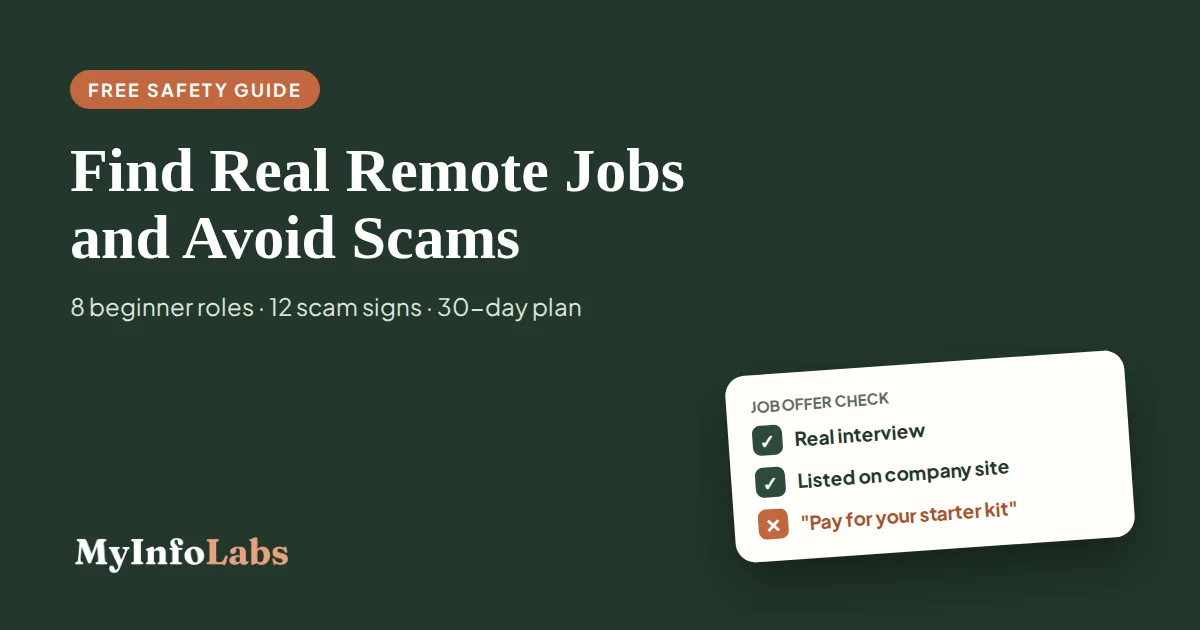
Real remote jobs are normal jobs done from home: you apply, interview and get paid by an employer or client. They are never “easy money”, and a real employer never charges you to start. Here’s where to look, which roles suit beginners, how to apply, and the 12 warning signs that tell you a job offer is a scam.
Key takeaways
- The golden rule: legitimate employers pay you. They never ask you to pay to get or start a job.
- Search on trusted job sites and apply directly on company career pages whenever you can.
- Use exact job titles, check which countries a “remote” job is open to, and apply early.
- Treat the search like a part-time job: one focused hour a day adds up.
In this guide
1. Eight beginner-friendly remote roles
| Role | What you do | Helpful skills |
|---|---|---|
| Customer support | Answer customer questions by chat, email or phone | Patience, clear writing |
| Virtual assistant | Email, scheduling and admin tasks for a business | Organisation, office tools |
| Online tutor | Teach a subject or language over video calls | Subject knowledge |
| Content writer | Write articles, product descriptions or emails | Good writing, research |
| Social media assistant | Schedule posts and reply to comments | Social platforms, design basics |
| Bookkeeping assistant | Record transactions and invoices | Spreadsheets, accuracy |
| Transcriptionist | Type up audio and video recordings | Fast, accurate typing |
| Sales or recruiting assistant | Contact leads or candidates and set up calls | Confidence, communication |
You’ll usually need a reliable computer and internet connection, a quiet place to work and take calls, and a simple, up-to-date resume. Be realistic: remote jobs are competitive, you’ll send many applications, and entry-level pay is usually modest.
2. Where to look
Use well-known job sites and go directly to company websites. Most legitimate employers list remote roles on their own “Careers” page too.
| Where | How to use it |
|---|---|
| LinkedIn Jobs | Set the “Remote” filter and follow companies you’d like to work for |
| Indeed and similar boards | Search your role plus “remote”, and check where the job is open to |
| Remote-only job boards | Sites that list only remote roles, such as We Work Remotely or Remote OK |
| Company career pages | The safest source. Apply directly on the company’s own website |
| Freelance platforms | Upwork, Fiverr and others for project-based work |
| Your own network | Tell friends, former colleagues and groups what you’re looking for |
Search tips that save time
- Check the location. Many “remote” jobs are only open to certain countries or time zones.
- Use exact job titles. “Customer support specialist” beats “online job”.
- Set job alerts so new listings come to your email every day.
- Apply early. Remote listings get many applicants in the first few days.
3. Twelve warning signs of a job scam
Fake job offers are common, especially for work-from-home roles. If something feels too easy or too fast, stop and check.
Red flags: no application or interview, unusually high pay, moving to a chat app, and asking for bank details.
4. How to check a company, and what to do if you’re targeted
- Find the company’s official website and careers page
- Check the job is listed there too
- Search the company name plus “scam” or “reviews”
- Look up its employees on LinkedIn
- Stop replying and don’t send money
- Contact your bank right away if you paid
- Report it to the job site
- Report it to your country’s fraud authority
In India, report online fraud on the National Cyber Crime Reporting Portal at cybercrime.gov.in or call the helpline 1930, especially quickly if money was lost. In the US, report to the FTC.
Get the free printable remote jobs guide
The role table, where to look, the scam checklist, an application tracker and the 30-day plan on 7 printable pages. No email needed.
Download the free PDF →5. Applications that stand out
Remote employers look for people who communicate clearly, manage their own time and are comfortable with online tools. Show those three things everywhere.
A short cover message formula
- Line 1: the role you’re applying for, and why this company.
- Lines 2–3: one or two relevant skills, each with a real example.
- Line 4: remote-ready habits, like working independently or using online tools.
- Line 5: a polite close and your availability for a call.
Video interview checklist
- Test your camera, microphone and internet beforehand.
- Sit with light in front of you and a plain background behind.
- Research the company before the call.
- Prepare 2–3 questions to ask them.
6. Your 30-day job-search plan
- Choose 2–3 target roles
- Update your resume
- Complete your LinkedIn profile
- Set up job alerts
- Send 10 tailored applications
- Send 10 more applications
- Message 5 people in your network
- Follow up on applications
- Practise interviews
- Learn one new skill
A simple one-hour daily routine: 10 minutes checking new job alerts, 30 minutes tailoring and sending 1–2 applications, 10 minutes following up or networking, and 10 minutes updating your tracker.
Questions job seekers ask
Are work-from-home jobs real?
Yes. Many companies hire for remote roles such as customer support, virtual assistance, tutoring and writing. Real jobs involve applying and interviewing, and the employer pays you, never the other way round.
Should I ever pay to get a job?
No. Legitimate employers don’t charge for training, starter kits or “registration”. A request for payment is one of the clearest signs of a scam.
How can I tell if a remote job offer is a scam?
Watch for unusually high pay for simple work, offers without a real interview, chat-app-only contact, early requests for bank details or ID, and cheques to buy equipment. Check that the job is listed on the company’s own website.
What should I do if I’ve been scammed?
Stop replying, contact your bank straight away if you paid anything, and report it to the job site and your country’s fraud authority. In India, use cybercrime.gov.in or call 1930.
How long does it take to find a remote job?
It varies. Remote roles are competitive, so expect to send many tailored applications over several weeks. A steady daily routine helps.
Building income alongside your search?
A job search can take time. If you’d also like to learn an online business skill at your own pace, our sister site IncomeJets offers a free Affiliate Marketing Course. It takes time and effort too, and no income is guaranteed.
Sources
- FTC: Don’t let job scams block your path forward
- Kerala Police: National Cyber Crime Reporting Helpline 1930
Related
Please note: General information only. Always do your own checks before accepting any job. The free course is offered by IncomeJets.com, a sister site of MyInfoLabs. See our disclaimer.