30-Day Home Workout for Beginners (No Equipment, 20 Minutes)
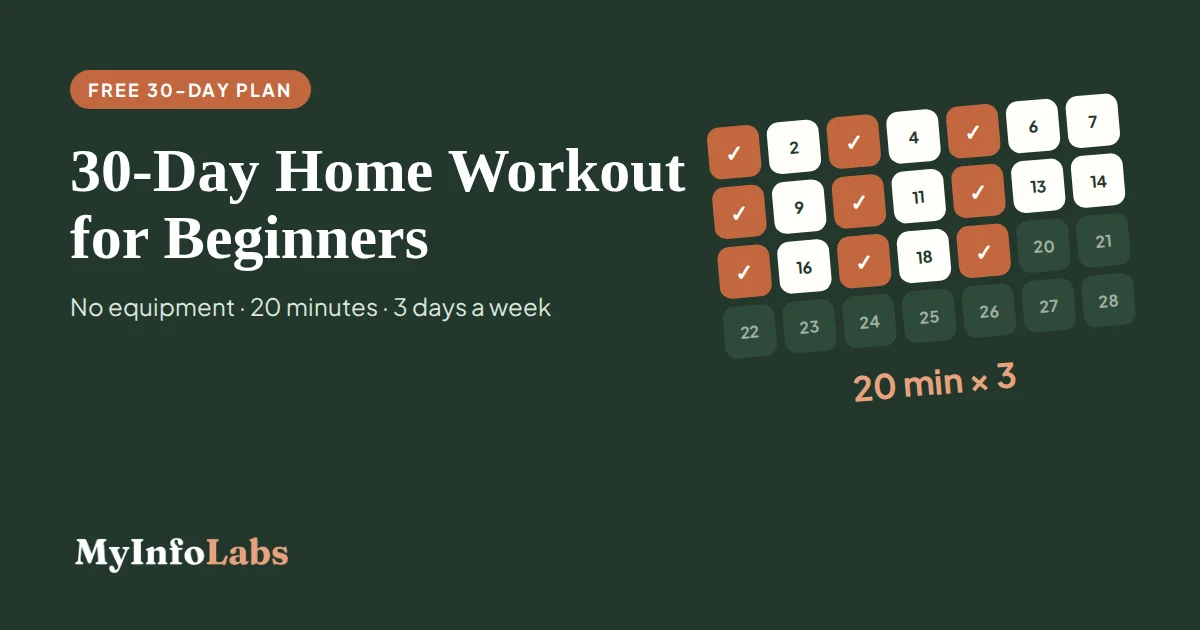
You don’t need a gym or any equipment to get stronger. Three short workouts a week, done consistently, is a great start for most beginners. This plan gives you 8 simple exercises with form tips, one 20-minute routine and a 4-week schedule that builds up gently.
Key takeaways
- Work out 3 days a week, such as Monday, Wednesday and Friday, with a brisk walk on other days.
- Each session is a 5-minute warm-up, a 12-minute circuit of 8 exercises and a 3-minute cool-down.
- Aim for about 6 out of 10 effort: you should still be able to talk in short sentences.
- Good form first. Mild muscle effort is normal; sharp pain means stop.
In this guide
1. Before you begin
Check with a doctor first if you…
2. Five-minute warm-up (do it first, every time)
- 1 min: march in place, swinging your arms.
- 30 sec: big, slow arm circles each way.
- 30 sec: gentle torso twists.
- 1 min: 10 slow chair squats.
- 1 min: step side to side.
- 1 min: heel raises and ankle circles.
3. Exercises 1–4: lower body and legs
Strong legs and hips make everyday life easier: climbing stairs, carrying shopping and getting up from the floor.
1. Chair squat
- Stand in front of a chair, feet hip-width apart.
- Push your hips back and lower until you lightly touch the seat.
- Press through your heels to stand tall.
Keep your chest up and knees in line with your toes. Easier: sit fully, then stand. Harder: no chair.
2. Glute bridge
- Lie on your back, knees bent, feet flat.
- Squeeze your glutes and lift your hips into a straight line.
- Pause for 2 seconds, then lower slowly.
Push through your heels and don’t arch your lower back. Harder: hold 5 seconds at the top.
3. Supported reverse lunge
- Hold a chair or wall for balance.
- Step one foot back and bend both knees gently.
- Push through the front heel to return. Switch sides.
Keep your front knee over your ankle. Easier: take a smaller step back.
4. Step-ups
- Use the bottom stair or a sturdy, low step.
- Step up with one foot, then the other.
- Step down the same way. Switch the lead leg halfway.
Place your whole foot on the step, and hold a rail if you have one.
4. Exercises 5–8: upper body and core
A strong upper body and core support good posture and protect your back during daily tasks.
5. Wall or knee push-up
- Hands on a wall (easiest), a counter, or the floor with knees down.
- Lower your chest toward your hands with a straight body.
- Push back to the start.
Elbows about 45° from your body. Progress: wall → counter → knees → toes.
6. Bird dog
- Start on hands and knees.
- Reach one arm forward and the opposite leg back.
- Hold for 2 seconds, return and switch sides.
Keep your back flat, like a table. Easier: move only the leg.
7. Plank
- Rest on your forearms, knees down (easier) or legs straight.
- Keep a straight line from head to knees or heels.
- Hold for the time in your plan, breathing steadily.
Don’t let your hips sag or lift high. 15–20 seconds is plenty to start.
8. Dead bug
- Lie on your back, arms up, knees bent at 90°.
- Slowly lower one arm and the opposite leg toward the floor.
- Return and switch sides.
Press your lower back gently into the floor. Easier: move only the legs.
Get the free printable workout plan
All 8 exercises, the routine, the 4-week schedule and a tick-off 30-day tracker on 7 printable pages. No email needed.
Download the free PDF →5. The 20-minute routine
Do this 3 times a week. Complete each exercise in order, rest about 30–60 seconds between exercises, then repeat for the rounds in your weekly plan.
| Part | What to do | Time |
|---|---|---|
| Warm-up | March in place, arm circles, torso twists and slow chair squats | 5 min |
| Circuit | Exercises 1–8 in order, for the reps or time in your weekly plan | 12 min |
| Cool-down | Slow walk around the room, then gentle stretches held 20–30 seconds each | 3 min |
Cool-down stretches: calf stretch against a wall, standing thigh stretch holding a chair, seated hamstring stretch, chest stretch in a doorway, shoulder stretch across your body, and child’s pose if comfortable. You should feel a mild pull, never pain.
6. Your 4-week plan
| Week | Rounds | Reps per exercise | Plank |
|---|---|---|---|
| Week 1 | 2 | 8 (each side for lunges and bird dog) | 15–20 sec |
| Week 2 | 2 | 10 | 20–25 sec |
| Week 3 | 3 | 10 | 25–30 sec |
| Week 4 | 3 | 12, or try a harder version | 30–40 sec |
- Take a 20–30 minute brisk walk
- Do some gentle stretching
- Have at least one full rest day
- Repeat the same week again
- Use the easier versions
- Rest longer between exercises
7. Track your progress
Test yourself on day 1 and again on day 30. Seeing the numbers change is one of the best ways to stay motivated.
| Simple fitness check | Day 1 | Day 30 |
|---|---|---|
| Chair squats in 30 seconds | ___ | ___ |
| Wall or knee push-ups (good form) | ___ | ___ |
| Plank hold (seconds) | ___ | ___ |
| How I feel (energy, 1–10) | ___ | ___ |
Questions beginners ask
Can you get fit at home without equipment?
Yes. Bodyweight exercises like squats, bridges, push-ups and planks build strength in all the major muscle groups, and a chair, wall or stair is all you need to adjust the difficulty.
How many days a week should a beginner work out?
Three strength sessions a week with rest days between is a good start. Public health guidelines suggest muscle-strengthening activity on at least 2 days a week, plus about 150 minutes of moderate activity such as brisk walking.
Is 20 minutes of exercise enough?
For a beginner, yes. Three 20-minute workouts plus brisk walks on other days is a realistic way to build the habit and get stronger.
Should I work out if I’m sore?
Mild muscle soreness is normal when you start. Use the easier versions or take a walk instead. Sharp pain, chest pain or dizziness means stop and seek medical advice.
Ready for the next level after 30 days?
If you’d like a structured follow-on program focused on stronger glutes and hips, the muscles that support your lower back and power everyday movement, Unlock Your Glutes is one option worth a look. Results vary, and check with your doctor before starting any new program.
Sources
Related
Health note & disclosure: General fitness information, not medical advice. Check with your doctor before starting a new exercise program. This post contains an affiliate link; if you buy through it, MyInfoLabs may earn a commission at no extra cost to you. See our disclaimer.