How to Start a Journaling Habit in 21 Days (5 Minutes a Day)
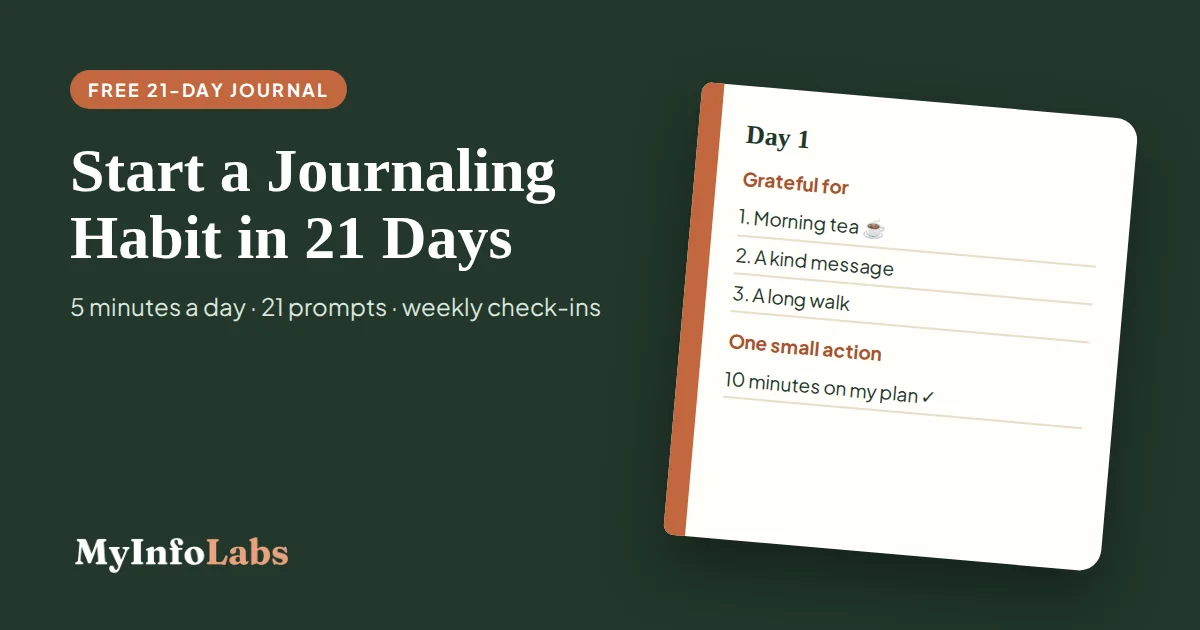
A daily journal is one of the simplest tools for getting clear on what you want, noticing what’s already good, and taking steady steps forward. You don’t need to write pages. Five minutes a day, split between morning and evening, is enough. This guide gives you the routine, 21 prompts and a three-week structure to make it stick.
Key takeaways
- Keep it to 5 minutes: one prompt, three gratitudes, one intention and one small action.
- Make your intention specific and within your control: “save $300 this month”, not “be rich”.
- Week 1 is for clarity, week 2 for gratitude and self-belief, week 3 for action.
- Missed a day? Just continue. Consistency matters more than perfection.
In this guide
1. Why a daily journal helps
Journaling isn’t about wishing harder. It’s about getting clear on what you want, keeping it in front of you every day, and backing it with small actions. Research consistently links gratitude with greater happiness, and noticing what you’re thankful for is a skill that, like a muscle, grows stronger with practice.
2. The 5-minute daily routine
- Pick a regular time, such as with your morning tea, and keep the journal there.
- Write by hand if you can. It helps you slow down and notice more.
- Do a short weekly check-in on days 7, 14 and 21.
3. Before day 1: set your intention
Take 10 minutes to answer these. You’ll come back to them at the end of each week.
- What I want to create in the next 90 days. Be specific: what, how much, by when.
- Why it matters to me. The deeper reason that will keep you going.
- How I’ll feel when it’s real. Describe the feeling in a few words.
- What might get in my way. Habits, beliefs or circumstances, and one way around each.
- My first small step. Something you can do in the next 24 hours.
Get the free printable 21-day journal
21 guided daily pages with gratitude lines, intention and action boxes, plus 3 weekly check-ins, on 16 printable pages. No email needed.
Download the free journal →4. 21 prompts in three weeks
Answer one prompt each morning in a few lines. Days 7, 14 and 21 double as your weekly check-ins.
- What do I truly want in the next 90 days, and why does it matter to me?
- If this goal were already real, what would an ordinary day look like?
- Which beliefs about this goal might be holding me back?
- Rewrite one limiting belief as a supportive statement I can honestly believe.
- Who already has what I want, and what can I learn from them?
- What am I willing to let go of to make room for this?
- What feels clearer to me now than it did on day 1?
- What in my life today would my younger self be proud of?
- Who has helped me get where I am, and how can I thank them?
- Describe a past win that proves I can make real changes.
- What small sign did I notice today that I’m moving forward?
- How do I want to feel this week, and what supports that feeling?
- What would I do today if I fully trusted myself?
- What has a week of gratitude changed in how I see things?
- What is the single most important action toward my goal this week?
- What habit would make my goal more likely, and how can I start small?
- Which distraction can I reduce, even by 10 minutes a day?
- Who can I ask for help, advice or encouragement?
- What did I learn from something that didn’t go to plan?
- How have I grown since day 1?
- Write a short letter from your future self, 90 days from now.
- Rate how connected you feel to your goal, 1–10
- Write your biggest win this week
- Note what you learned
- Choose your focus for next week
5. Tips to make the habit stick
Common questions
How long should I journal each day?
About 5 minutes is enough: a short prompt answer, three gratitudes, one intention and a quick evening note. Short and daily beats long and occasional.
Is it better to journal in the morning or at night?
Both work. A morning entry helps you set an intention for the day, and a one-line evening note helps you notice what went well. Pick the time you can keep.
What should I write in a gratitude journal?
Three specific things you’re thankful for today, big or small: a kind message, a good meal, finishing a task. Specific details make it more meaningful than general lists.
Can journaling replace professional help?
No. Journaling is a tool for reflection and personal growth. If you’re struggling with your mental health, please talk to a doctor or a qualified professional.
Just for fun
Some readers like to pair their journaling with other reflective tools. If you’re curious, Numerologist.com offers a free personalised numerology video reading based on your name and birth date. Treat it as entertainment and a prompt for reflection, not as science or advice.
Sources
Related
Disclosure: The Numerologist.com link is an affiliate link. The reading is free; if you choose to buy an optional report, MyInfoLabs may earn a commission at no extra cost to you. This journal is a tool for reflection and personal growth; it does not guarantee any outcome and is not a substitute for professional financial, medical or psychological advice. See our disclaimer.